
During a symposium titled "Cracked Cliches After the Ramadan Battle," members of the faculty at the University of Kurdistan gathered to analyze and critique prevalent misconceptions within the realms of governance, security, and social relations. The session was held on Sunday, April 19, in the university's conference hall.
Review and Analysis of "Cracked Cliches" in Governance and Security at the University of Kurdistan Faculty Symposium
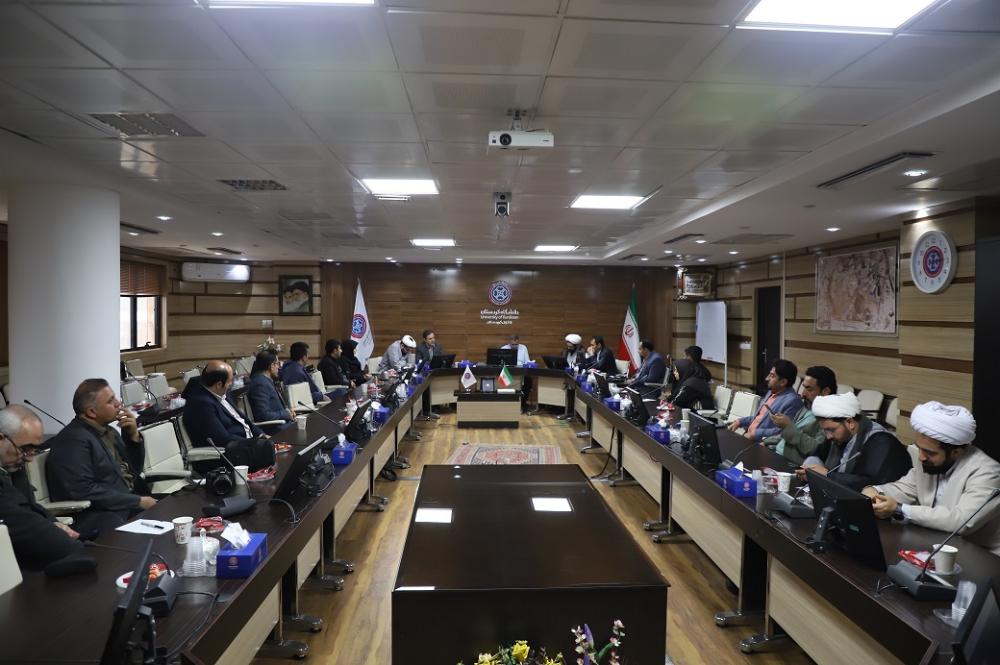



According to the University of Kurdistan Public Relations office, the participating professors emphasized the necessity of re-evaluating established cliches, such as the artificial separation of "Iran" from the "Islamic Republic" and simplistic views regarding power structures and public opinion.
The Separation of Iran from the Islamic Republic and Kurdish Separatism as Cliches
Hojjat-ol-Islam Abedin Rostami, the Representative of the Supreme Leader at the University of Kurdistan, rejected several common misconceptions during the session. He asserted that Iran cannot be viewed as separate from the Islamic Republic and characterized the attribution of separatism to the Kurdistan region as an inaccurate cliche.
Hojjat-ol-Islam Rostami addressed the notion that the Islamic Republic is "centered on a single individual," labeling it a frequent but false cliche. He noted that in the political thought of Imam Khomeini and the martyred Imam, it is emphasized that the system is not dependent on one person but is a robust structure with a defined legal framework and established foundations. He identified three pillars for the system’s survival: the people’s beliefs, ideology, and leadership.
He further argued that the rhetoric of "having an issue with the system but not the people" is an enemy-constructed cliche debunked at great cost. Since the system is legally rooted in the citizenry, it is inseparable from them. He highlighted that the "Republic" and "Islam" are the two fundamental pillars; a challenge to either affects the integrity of the entire system. Regarding potential alternatives, he noted that Western strategists have proposed "partition" as the intended substitute for the Islamic Republic.
Defending the Kurdistan region, Rostami stated that labeling Kurds as separatists is a fallacy, asserting that "Kurdistan is the soul of Iran." He recalled the region's historical contributions to the Islamic Revolution and its defense of the borders when formal military structures were still being organized. On security, he maintained that the distinction between national and social security is a cliche; the two are inextricably linked. He also critiqued the idea of a universal political model, stating that each country’s unique conditions require specific solutions. Finally, he emphasized that peace is distinct from appeasement and requires defensive readiness, while noting that the belief that a single party can solve all problems is another cliche that must be discarded in favor of utilizing all national capacities.
Cracks in the Cliches of Governance
Khabat Nesaei, a faculty member of the Department of Management, addressed common perceptions of governance, noting that recent evidence suggests cliches such as the "person-centered system" and the "separation of Iran from the Islamic Republic" are beginning to fracture.
Nesaei argued that events like the 12-day war and the Ramadan Battle demonstrated that the country’s administrative and military structures do not collapse with the removal of a senior official. He contrasted this with systems that crumble upon the loss of top leadership, noting that even after the loss of the President in 2024, Iran’s executive structure remained functional, indicating a stable bureaucracy. He further explained that media efforts to decouple "Iran" from the "Islamic Republic" fail in practice, as an attack on the system is an attack on the country's infrastructure.
National Security is Tied to Identity
Bahman Sobhani, PhD in Social Planning and lecturer at Farhangian University, described security as a subjective perception and a social production. He characterized security as a "hegemonic element" that encompasses all dimensions of life.
Sobhani noted that during conflicts, the disruption of police and administrative structures initially creates a sense of external insecurity, which eventually spreads to vital infrastructure, affecting food security and other essential sectors. He referenced the experience of countries like Afghanistan to show that foreign interventions do not necessarily lead to stability or the quick restoration of structures.
He further analyzed the triad of public, social, and national security. Public security involves protecting lives and property; social security involves maintaining order against threats; and national security is the state's ability to preserve territorial integrity and sovereignty. Sobhani concluded that national security is deeply tied to identity, and its weakening leads to the erosion of collective identity, necessitating social planning to prevent the formation of social rifts.


Quick Links
Electronic Services
Useful Links


University of Kurdistan, Pasdaran Boulevard, Sanandaj, Iran

Postal Code: 6617715175

Phone: +988733664600-8

Email: info@uok.ac.ir


site visit
- today:
- yesterday:
- all:
Last Update
20 Apr 2026 - 08:35:39